|
|
||
|---|---|---|
| src | ||
| .gitignore | ||
| Cargo.lock | ||
| Cargo.toml | ||
| CHANGELOG.md | ||
| README.md | ||
| screenshot.png | ||


cove
Cove is a TUI client for euphoria.io, a threaded real-time chat platform.
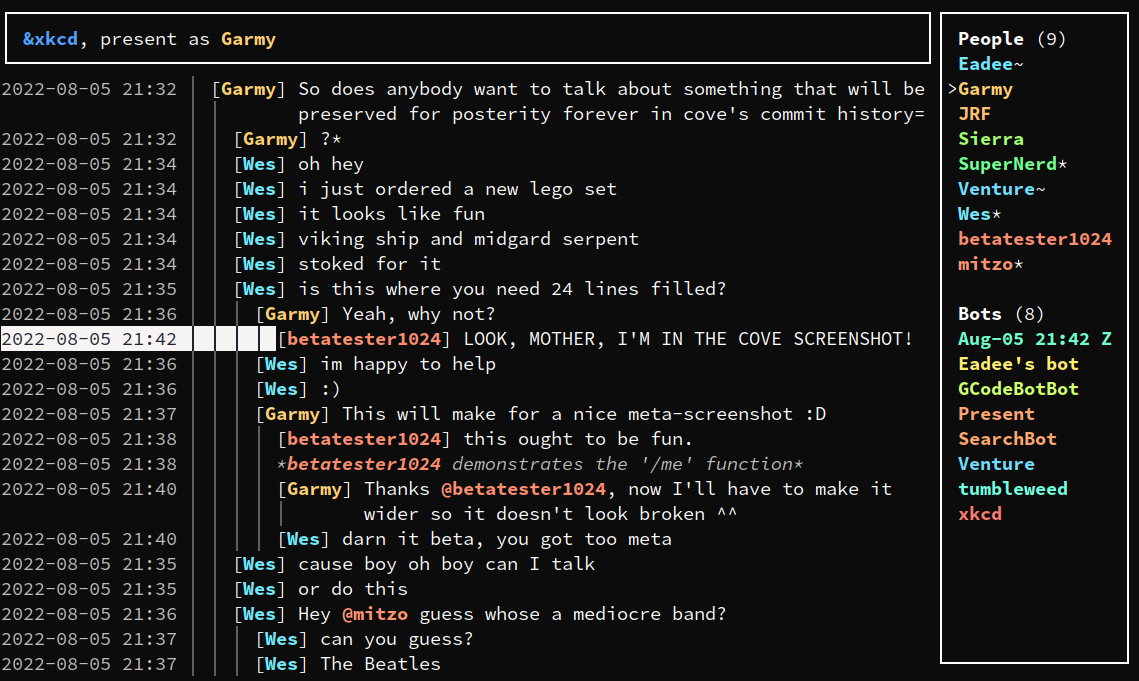
It runs on Linux, Windows and macOS.
Using cove
To start cove, simply run cove in your terminal. For more info about the
available subcommands such as exporting room logs or resetting cookies, run
cove --help.
If you delete rooms, cove's vault (the database it stores messages and other
things in) won't automatically shrink. If it takes up too much space, try
running cove gc and waiting for it to finish. This isn't done automatically
because it can take quite a while.
Manual installation
This section contains instructions on how to install cove by compiling it yourself. It doesn't assume you know how to program, but it does assume basic familiarity with the command line on your platform of choice. Cove runs in the terminal, after all.
Installing rustup
Cove is written in Rust, so the first step is to install rustup. Either install it from your package manager of choice (if you have one) or use the installer.
Test your installation by running rustup --version and cargo --version. If
rustup is installed correctly, both of these should show a version number.
Cove is designed on the current version of the stable toolchain. If cove doesn't compile, you can try switching to the stable toolchain and updating it using the following commands:
$ rustup default stable
$ rustup update
Installing cove
To install or update to the latest release of cove, run the following command:
$ cargo install --force --git https://github.com/Garmelon/cove --branch latest
If you like to live dangerously and want to install or update to the latest, bleeding-edge, possibly-broken commit from the repo's main branch, run the following command.
Warning: This could corrupt your vault. Make sure to make a backup before running the command.
$ cargo install --force --git https://github.com/Garmelon/cove
To install a specific version of cove, run the following command and substitute in the full version you want to install:
$ cargo install --force --git https://github.com/Garmelon/cove --tag v0.1.0
Config file
Cove's config file uses the TOML format.
When launched, cove prints the location it is loading its config file from. To
configure cove, create a config file at that location. This location can be
changed via the --config command line option.
The following is a complete list of available options. If a command line option with the same purpose exists, it takes precedence over the option specified in the config file.
data_dir
Type: String (representing path)
Default: Platform dependent
The directory that cove stores its data in when not running in ephemeral mode.
Relative paths are interpreted relative to the user's home directory.
See also the --data-dir command line option.
ephemeral
Type: Boolean
Default: false
Whether to start in ephemeral mode.
In ephemeral mode, cove doesn't store any data. It completely ignores any options related to the data dir.
See also the --ephemeral command line option.
offline
Type: Boolean
Default: false
Whether to start in offline mode.
In offline mode, cove won't automatically join rooms marked via the autojoin
option on startup. You can still join those rooms manually by pressing a in
the rooms list.
See also the --offline command line option.
euph.rooms.<room>.autojoin
Type: Boolean
Default: false
Whether to automatically join this room on startup.
euph.rooms.<room>.username
Type: String
Default: Not set
If set, cove will set this username upon joining if there is no username associated with the current session.
euph.rooms.<room>.force_username
Type: Boolean
Default: false
If euph.rooms.<room>.username is set, this will force cove to set the username
even if there is already a different username associated with the current
session.
euph.rooms.<room>.password
Type: String
Default: Not set
If set, cove will try once to use this password to authenticate, should the room be password-protected.